Last class: introducing yourself and your hobbies → today: introducing a family, and numbers.
课本 Textbook新HSK教程 1 · 第 4 课
The words and grammar follow Lesson 4 of the textbook (我有两个孩子). The dialogues are written for you: you're a student who loves reading, so we talk about books — Harry Potter and 《三体》 — instead of the book's own texts.
上次的课 Last class难点和提问
难点 Tricky point: ü in 去 qù — everything else in the pronunciation check was fine.
接着问 Follow-up: 大学生还是研究生? — in part 05.
Your name 艾乐知 and its meaning — part 01.
你的兴趣 Your interests爱好 · 文化 · 生活 · 科学与健康
Hobbies — reading: 《哈利·波特》《三体》, and a Chinese show, 《致我们单纯的小美好》. Culture — family names (with Korean), number culture and shopping festivals, student life in numbers. Science — 《三体》.
All four skills: 听 warm-up & texts · 说 texts & part 05 · 读 texts & culture · 写 homework.
01
复习 · 上次的课
Review — last class
上次的课 · 你的中文名字Last class — your Chinese name and introducing yourself
艾乐知
Ài Lèzhī
点击查看意思 What does it mean?
艾 Ài — surname, the "E-" sound · 乐 lè — to enjoy, to find joy in · 知 zhī — to know
乐知 = "finding joy in knowing". It comes from Confucius: 知之者不如好之者,好之者不如乐之者 — "Those who know it are not as good as those who love it; those who love it are not as good as those who enjoy it." A name for someone who learns languages for fun.
我叫艾乐知。Wǒ jiào Ài Lèzhī.My name is Ai Lezhi.
我是学生。Wǒ shì xuéshēng.I'm a student.
我喜欢看书。Wǒ xǐhuan kàn shū.I like reading.
+ 今天 Today you can add:我家有……口人。Wǒ jiā yǒu … kǒu rén.There are … people in my family.
拼音小复习Pinyin review
✓
上次的发音检查Last class's pronunciation check
上次课我们检查了你的发音。我挑的都是最容易出错的音——你整体发得都很好,没有问题!
Last class we checked your pronunciation on the sounds learners most often get wrong — and overall you had no problems! Only one sound gets one more look today: ü.
If I notice a sound that needs a little more work during today's class, I'll note it here — and we'll go over it next lesson.
(还没有 · nothing yet)
In 课堂笔记 Notes, tap 发音 Pronunciation and write the sound — it shows up here.
ü · 去 qù
发音方法 How to make it
舌位跟 i 一样:舌尖抵住下齿背,舌面前部抬高;嘴唇拢圆,向前突出。先发 i,舌头不动,嘴唇由扁变圆,就是 ü。
Use the same tongue position as Chinese i: the tip of the tongue touches the back of the lower front teeth, and the front of the tongue is raised. Then round your lips and push them forward — more rounded and protruding than English "oo". Say i, keep the tongue still, and change only the lips.
舌头不动,只动嘴唇 Same tongue — only the lips change七 qī→去 qù你 nǐ→女 nǚ
拼写 Spelling
After j, q, x and y, ü is written u: qu, xue, yun — but it is still ü. After n and l the dots stay (nü, lü), because nu and lu are different syllables.
听一听,连一连Who's who in a family? Listen, then match the sound to the picture
一只手数到十Counting 1–10 on one hand
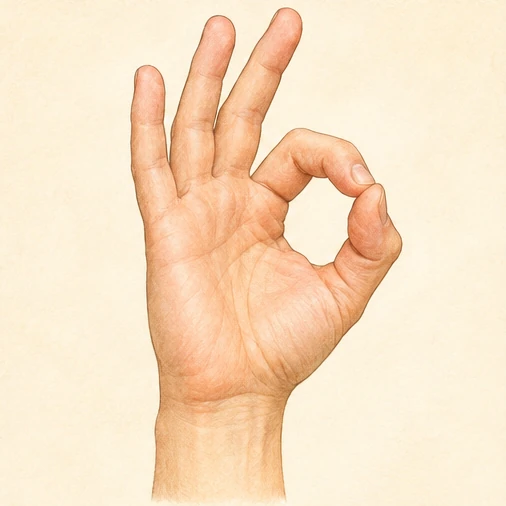
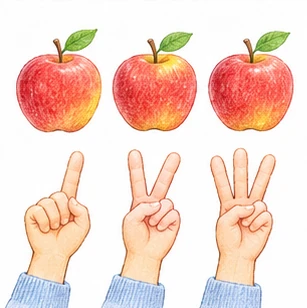
In China people show 1–10 with one hand. Most of 1–5 are what you'd expect — but look at 3. 6–10 have their own signs; 10 is usually just a fist. Very useful at a market! (Signs differ a little from place to place.)
1
一yī
Index finger up
2
二èr
Index and middle fingers up
3
三sān
Thumb and index finger touch in a ring, the other three fingers up — or hold down the little finger with the thumb
4
四sì
Thumb folded into the palm, four fingers up
5
五wǔ
All five fingers open
6
六liù
Thumb and little finger out — like a phone
7
七qī
Tips of the thumb, index and middle fingers pinched together
8
八bā
Thumb and index finger out — an "L", like the character 八
9
九jiǔ
Index finger bent into a hook
10
十shí
A closed fist. (Some people cross two index fingers instead, like 十.)
小游戏 · Mini game: what number is it? (1–10)
?
03
课文 · 介绍一家人
Texts — introducing a family
你家有几口人?
Nǐ jiā yǒu jǐ kǒu rén?
How many people are in your family? — the question of the day
黄色 = new words蓝色 = grammarClick any word for pinyin and meaning
先认识这本书 Before we start: the book
《哈利·波特》 is by the British writer J.K. 罗琳 Luólín. The Chinese edition came out in 2000. Most names in it are 音译 yīnyì — translated by sound, so they sound like the English:
Some words are 意译 yìyì — translated by meaning: the first book is 《哈利·波特与魔法石》, "and the magic stone" (the Philosopher's Stone). Today's main character is Harry's best friend, 罗恩 — he comes from a very big family.
课文 1 罗恩家有几口人? · 上课的时候,晓静老师看到乐知在看一本书。How many people are in Ron's family? · In class, Xiaojing sees the book Lezhi is reading.
先听再读 · Listen first, then answer
罗恩家有____口人。There are ____ people in Ron's family.
哈利有哥哥吗?他____哥哥。Does Harry have an older brother? He ____ .
晓静
乐知,这是什么书?
Lezhi, what book is this?
你
《哈利·波特》。我很喜欢罗恩。
Harry Potter. I really like Ron.
晓静
罗恩家有几口人?
How many people are there in Ron's family?
你
九口人。他爸爸妈妈有七个孩子:六个儿子,一个女儿。
Nine. His parents have seven children: six sons and one daughter.
晓静
罗恩有几个哥哥?
How many older brothers does Ron have?
你
他有五个哥哥和一个妹妹。
He has five older brothers and one younger sister.
晓静
哈利呢?他有哥哥吗?
What about Harry? Does he have an older brother?
你
他没有哥哥,也没有妹妹。
He doesn't have an older brother, or a younger sister.
您今年贵庚?very respectful — for adults, especially older people or formal moments
您儿子几岁?Nín érzi jǐ suì?How old is your son? (he is five)
您女儿多大?Nín nǚ'ér duō dà?How old is your daughter? (she is twelve)
您多大年纪?Nín duō dà niánjì?How old are you? (to an older person)
Once someone is over 10, 岁 is sometimes dropped in casual speech: 她今年十二。 But keeping it is always correct — and the safer choice, especially in writing: 她今年十二岁。 Under 10, always keep 岁: 他五岁。
05
说说你
About you — only what you want to share
Answer only what you'd like to share. You can also answer as a character you like — Ron would say 我有五个哥哥!
你家有几口人?
Nǐ jiā yǒu jǐ kǒu rén?
How many people are in your family?
你有哥哥、姐姐吗?
Nǐ yǒu gēge, jiějie ma?
Do you have older brothers or sisters?
你是大学生还是研究生?
Nǐ shì dàxuéshēng háishi yánjiūshēng?
Are you an undergraduate or a graduate student?
你今年多大?
Nǐ jīnnián duō dà?
How old are you this year? (optional)
你有多少本书?
Nǐ yǒu duōshao běn shū?
How many books do you have? — you like reading!
你喜欢看什么书?
Nǐ xǐhuan kàn shénme shū?
What books do you like to read?
还是 háishi — "or" in questions (a preview)
A 还是 B? asks someone to choose: 你是大学生还是研究生? You'll learn it properly later; for now use it as a chunk. 大学生 dàxuéshēng = university student, 研究生 yánjiūshēng = graduate student (master's or PhD).
06
文化和汉字
Culture & characters
中国人怎么叫家人?What Chinese people call their family — with Korean side by side
Chinese family words tell you which side of the family someone is on and who is older. Korean does the same — and even uses the same character 外 외 for mum's side!
爷爷
dad's father
yéye할아버지
奶奶
dad's mother
nǎinai할머니
外公
mum's father
wàigōng외할아버지
外婆
mum's mother
wàipó외할머니
爸爸
dad
bàba아빠 · 아버지
妈妈
mum
māma엄마 · 어머니
哥哥
older brother
gēge오빠 / 형
姐姐
older sister
jiějie언니 / 누나
我
me
wǒ나
弟弟
younger brother
dìdi남동생
妹妹
younger sister
mèimei여동생
One word, two in Korean. 哥哥 is 오빠 if you're a woman and 형 if you're a man — Chinese doesn't care who is speaking.
外 = outside = 외. Mum's parents are 外公 / 外婆 in Chinese and 외할아버지 / 외할머니 in Korean. In the north many people say 姥爷 lǎoye / 姥姥 lǎolao instead.
口 = mouth = 식구. Chinese counts family members with 口: 四口人. Korean 식구 is written 食口 — "the mouths that eat together".
练一练 Practice
爸爸的妈妈叫什么?What do you call your dad's mother?
奶奶。Nǎinai.
妈妈的爸爸叫什么?What do you call your mom's father?
外公。北方人也说姥爷。Wàigōng — or lǎoye in the north.
金妮叫罗恩什么?What does Ginny call Ron?
哥哥。罗恩是她哥哥。Gēge — Ron is her older brother.
数字文化Lucky and unlucky numbers — click a card
8
八 bā · lucky — sounds like 发 fā, "get rich"
Eight sounds close to 发 (发财 fācái, to get rich), so it's the favourite number in China. The Beijing 2008 Olympics were scheduled to open at 8:08 pm on 8 August 2008. Phone numbers and car plates full of 8s can cost extra.
八八八,发发发!Eight, eight, eight — rich, rich, rich!
4
四 sì · unlucky — sounds like 死 sǐ, "die"
Four (sì) sounds like 死 sǐ, "to die". Some buildings skip the 4th floor or rooms with 4. Korea has the same idea: 사 四 sounds like 사 死, and in some elevators the 4th floor button says F.
四和死很像。四 and 死 sound alike.
6
六 liù · smooth — 六六大顺
六六大顺 liùliù dà shùn means "everything goes smoothly" — a common New Year wish. Online, 666 means "awesome, so skilled!"
六六大顺!May everything go smoothly!
9
九 jiǔ · long-lasting — sounds like 久
九 jiǔ sounds like 久 jiǔ, "long-lasting". When it's used: the 9th day of the 9th lunar month, 九月初九, is 重阳节 Chóngyáng Jié, the Double Ninth Festival — since 1989 also China's day for older people, when families visit their 爷爷、奶奶. It's also popular at weddings: 九九 sounds like 久久, "for a long, long time".
九和久一样。九 and 久 sound the same.
520
五二零 · "I love you" online
五二零 wǔ èr líng sounds a bit like 我爱你 wǒ ài nǐ. So 20 May (5/20) has become an internet "Valentine's Day" in China, and many couples choose it as their wedding day. The next day counts too: 五二一 is the reply — read as 我愿意 "I do", or simply another 我爱你. So 520 + 521 = "I love you — me too / I do". And 一三一四 sounds like 一生一世, "for a whole lifetime".
五二零 = 我爱你520 = I love you
一
yāo · 1 on the phone = yāo
110
When reading phone, room or bus numbers digit by digit, people usually say yāo for 1. 幺 means "the smallest", and yāo is hard to mix up with 七 qī — the habit spread from army radio talk. Saying yī is not wrong, just less common. 110 (police) is read yāo yāo líng.
一一零yāo yāo líng — 110
11.11
双十一 shuāng shíyī · Singles' Day → shopping day
11 November has four 1s, like four single people standing alone. The story usually told: in 1993 some students at Nanjing University joked about it in their dorm, and 光棍节 guānggùn jié, "Singles' Day", spread through universities. In 2009 Taobao held a sale that day, and 双十一 became China's biggest online shopping festival. 双 = a pair: 两个十一.
韩国 Korea: 11/11 is 빼빼로 데이 Pepero Day — the snack sticks look like 1s. Korea's singles' day is Black Day, 4/14, when singles eat 짜장면 jjajangmyeon — that's 炸酱面 zhájiàngmiàn!
双十一shuāng shíyī — "double eleven"
618
六一八 liù yāo bā / liù yī bā · the mid-year sale
The shopping site JD.com (京东) was founded on 18 June 1998, so 6·18 is its birthday sale — and now almost every platform joins in. It's read digit by digit. Most people say liù yāo bā, using yāo for 1 like in a phone number; you'll also hear liù yī bā — both are fine. With yāo, 一八 yāo bā sounds like 要发 yào fā, "going to get rich". Lucky for a sale!
六一八liù yāo bā
练一练 Practice
中国人喜欢哪些数字?Which numbers do Chinese people like?
很多人喜欢六、八、九。6 = smooth, 8 = get rich, 9 = long-lasting.
"双十一"为什么叫"双"?Why is it called "double" eleven?
因为有两个"十一":十一月十一号。Because there are two elevens: 11 November.
618 怎么说?How do you say 618?
六一八。liù yāo bā — digit by digit, usually yāo for 1 (liù yī bā is fine too).
中国的大学生活University students in numbers: how old, how many in a dorm room?
In China, most 大学生 live on campus in a 宿舍, sharing a room with classmates, and eat in the 食堂. 本科生 get in through the 高考 at about 十八岁 — so most are 十八岁 to 二十二岁.
宿舍有几个人? It differs: 四个人, 六个人, even 八个人. New dorms are planned for 四个人 (本科生) and 两个人 (研究生).
大学生dàxuéshēnguniversity student研究生yánjiūshēnggraduate student (master's/PhD)宿舍sùshèdormitory食堂shítángcanteen图书馆túshūguǎnlibrary — for a reader like you!
练一练 Practice
中国大学生多大?How old are Chinese university students?
十八岁到二十二岁。shíbā suì dào èrshí'èr suì — about 18 to 22
本科生宿舍有几个人?How many people in an undergraduate dorm room?
四个人,也有六个、八个。sì gè rén, yě yǒu liù gè, bā gè — four; sometimes six or eight
研究生呢?And graduate students?
新宿舍是两个人。xīn sùshè shì liǎng gè rén — new dorms: two per room
Last class you learned 会意 meaning + meaning (女 + 子 = 好). Today: 形声 meaning + sound — most Chinese characters, about 80% or more, are made this way. Once you see the pattern, you can often guess the meaning and the sound of a new character.
形声 Meaning + sound — one part tells you what it's about, the other tells you roughly how to say it. The tone often changes, and some sounds have drifted over 2,000 years.
Spot the family · 女 family and 马 family
女 woman → 妈 姐 妹 好 (好 is 会意, not 形声!)
马 mǎ sound → 妈 mā · 吗 ma · 骂 mà (to scold) — all "ma"!
mā
女woman+马mǎ → sound=妈mom
女 tells you it's about a woman; 马 mǎ (horse) gives the sound. mǎ → mā: same syllable, new tone.
字 今天学 today 字 学过 learned 字 下节课预习 next class (第三课 · 课本参考第 5 课《今天我休息》) Next class: 日 and 月 are pictures of the sun and moon, and 休 (rest) is a person 亻 leaning on a tree 木.
Ancient forms: Wikimedia Commons, Ancient Chinese Characters Project (public domain). 爸 and 妈 are younger characters — they don't appear on oracle bones, so they have no old forms here.
07
总结和作业
Summary & homework — everything is on this page
今天学了什么Today in one look
词语 Words
爸爸
bàbadad这是我爸爸。This is my dad.
妈妈
māmamom我妈妈喜欢看书。My mom likes reading.
哥哥
gēgeolder brother罗恩有五个哥哥。Ron has five older brothers.
妹妹
mèimeiyounger sister他有一个妹妹。He has a younger sister.
孩子
háizichild, children他爸爸妈妈有七个孩子。His parents have seven children.
儿子 · 女儿
érzi · nǚ'érson · daughter六个儿子,一个女儿six sons and one daughter
他 · 她
tāhe · she — same sound他没有哥哥。He doesn't have an older brother.
家
jiāfamily, home罗恩家有九口人。There are nine people in Ron's family.
语法 Grammar
A、B 和 C
héand — joins nouns; goes before the last one五个哥哥和一个妹妹five older brothers and a younger sister
也学了 Bonus words
奶奶
nǎinaigrandma (dad's mother)我奶奶身体很好。My grandma is very healthy.
家人
jiārénfamily members这是你的家人吗?Is this your family?
语法 Grammar
有 / 没有
yǒu / méiyǒuhave / not have — never 不有他没有哥哥,也没有妹妹。He has no older brother or younger sister.
数 + 量 + 名
number + measure word + noun个 most things · 口 family members · 本 books罗恩家有九口人。There are nine people in Ron's family.
两 or 二?
liǎng / èr两 before a measure word; 二 when counting and in 十二, 二十罗恩的两个哥哥是双胞胎。Ron's two brothers are twins.
几 or 多少?
jǐ / duōshao几 for small numbers (under 10) · 多少 for any number你有多少本书?How many books do you have?
数字 Numbers
十一 · 六十三
shíyī · liùshísān11 · 63 — like maths他今年六十三岁。He's 63 this year.
二百零八
èrbǎi líng bā208 — say 零 for the gap二百零八208
一千五百二十八
yìqiān wǔbǎi èrshíbā1,528一千五百二十八1,528
语法 Grammar
几岁?
jǐ suìto children under about 10他妹妹几岁?How old is his little sister?
多大?
duō dàto young people and adults罗恩多大?How old is Ron?
多大年纪?
duō dà niánjìto older people — more polite他今年多大年纪?How old is he?
岁 can go
suìafter 10 you can drop 岁他们十三。They're thirteen.
词语 Words
今年
jīnniánthis year他今年六十三岁。He's 63 this year.
岁
suìyears old罗恩十一岁。Ron is eleven.
问一家人 Asking about a family
你家有几口人?
nǐ jiā yǒu jǐ kǒu rénHow many people are in your family?你家有几口人?How many people are in your family?
你有哥哥、姐姐吗?
nǐ yǒu gēge, jiějie maDo you have older brothers or sisters?你有哥哥、姐姐吗?Do you have older brothers or sisters?
……呢?
… neWhat about …?哈利呢?他有哥哥吗?What about Harry? Does he have an older brother?
聊书 Talking about books
这是什么书?
zhè shì shénme shūWhat book is this?乐知,这是什么书?Lezhi, what book is this?
……有几本?
… yǒu jǐ běnHow many books are in the series?《三体》有几本?How many books are in The Three-Body Problem?
我不知道有多少本。
wǒ bù zhīdào yǒu duōshao běnI don't know how many.很多!我不知道有多少本。Lots! I don't even know how many.
Your answers are saved automatically in this browser. When you're done, click 完成 · 整理给老师 at the bottom and send me the text on italki. About 30 minutes in total.
1
听一听,读一读
Listen & read aloud — tick each one when you've done it
2
写一写:书里的一家人
Pick a book or a show you like, and write 5–7 sentences about one family in it
《……》里,……家有……口人。how many……有……个哥哥 / 妹妹。brothers & sisters……没有……,也没有……。with 没有……今年……岁。ages……的爸爸妈妈有……个孩子。children……喜欢……。what they like
0 字 characters · You can also write in pinyin.
3
选词填空 · 打字练习
From today's texts — type the missing word
罗恩家有__口人。nine — jiǔ
你家有几__人?measure word — kǒu
哈利__?他有哥哥吗?what about…? — ne
哈利__有哥哥。doesn't have — méi
他今年多大__?age (for older people) — niánjì
刘慈欣今年__岁。63 — liùshísān
How many people are in your family?nǐ jiā yǒu jǐ kǒu rén
He has five older brothers.tā yǒu wǔ gè gēge
4
写汉字
Write characters with your mouse or finger
Pick a character. Click 看笔顺 to watch the strokes, then 自己写. (Needs an internet connection.)
5
说一说 · 跳跳障碍
Say it right and Xiaobao jumps over the wall!
在听 Listening0 / 9
Say the word on the sign. When the computer hears it right, Xiaobao jumps.
电脑听到了什么? What the computer heard
If a word keeps failing, send this list to your teacher.
怎么算说对? How does it know I said it right?
Your browser turns your voice into Chinese characters (speech recognition — the same thing as voice typing on a phone). If the characters it hears are the word on the sign, that's a pass and Xiaobao jumps. If it hears a word with the same sounds but different tones, you get 差一点 · so close — check the tones and say it again. If the wall reaches Xiaobao first, it just waits for you — keep trying, or press to listen.
★ = passed before the wall reached Xiaobao. Works in Chrome, Edge and Safari (needs the internet); allow the microphone when asked.
6
生词表 → Anki / Quizlet
Today's 21 words — untick what you already know
Anki: File → Import → choose the .txt · Fields separated by Tab · tick "Allow HTML". Quizlet: Create → Import → paste, "Between term and definition: Tab".
下节课预告 Next lessonLESSON 03日期和休息日Dates and days off今天几月几号?星期几?中国人休息的时候做什么?What's the date? What day is it? What do people in China do on their days off?课本参考:新HSK教程 1 第 5 课《今天我休息》Based on New HSK Course 1, Lesson 5 "I'm off today"
几月几号?星期几?
Dates and days of the week — and a surprise about where the Korean names for the days come from.
你会做什么?
Talk about the things you're good at — and the ones you'd like to learn.
中国的节日
Which days are special in China, and what people do on them.
休息日做什么?
反向旅游、小众旅行、成人兴趣班 — new ways young people spend their time off.
Click, then paste the text into an italki message to me.
08
课堂反馈
How was today?
你觉得今天的课怎么样?
Nǐ juéde jīntiān de kè zěnmeyàng?
How did you feel about today's lesson? Was the level OK?
太简单了 too easy正好 just right有点儿难 a bit hard
你有什么意见和建议?
Nǐ yǒu shénme yìjiàn hé jiànyì?
Anything you'd like more or less of? Pick any, or write your own.
多练口语 more speaking多讲语法 more grammar多学汉字 more characters多聊文化 more culture慢一点 slower快一点 faster作业多一点 more homework作业少一点 less homework
Then paste it into an italki message to me.
下节课:第三课 · 日期和休息日(课本参考新HSK教程 1 第 5 课《今天我休息》)
Next: Lesson 3 · Dates and days off (based on New HSK Course 1, Lesson 5 "I'm off today")
《哈利·波特》有七本。Seven books. Harry goes to 霍格沃茨 Huògéwòcí (Hogwarts) at eleven — in the first book he, Ron and their friends are all 十一岁.
一家人 Family
Ron's family is the big one: 爸爸亚瑟, 妈妈莫丽 and seven children — six sons and one daughter. Harry is the opposite: 他没有哥哥,也没有妹妹.
比尔哥哥查理哥哥珀西哥哥弗雷德哥哥乔治哥哥罗恩金妮妹妹
中文名 Names
Chinese names copy the sound: 哈利 Hālì, 罗恩 Luó'ēn, 赫敏 Hèmǐn (Hermione), 金妮 Jīnnī.
《三体》Sān TǐThe Three-Body Problemnovel by 刘慈欣 Liú Cíxīn · 2008 · Chinese series 2023 · Netflix 2024
书 Books
《三体》有三本。Three books: 《三体》, 《黑暗森林》 The Dark Forest, 《死神永生》 Death's End. The English translation by Ken Liu was the first novel by an Asian writer to win the Hugo Award for Best Novel.
作者 Author
刘慈欣 was born in 1963 — 他今年六十三岁。 He was a computer engineer before he wrote full-time.
科学 Science
The "three-body problem" is a real physics problem: three bodies, like three suns, pulling on each other by gravity move in ways no simple formula can predict. In the novel, aliens live on a planet with three suns.
看剧 Watch
Chinese series 《三体》 (2023, 30 episodes) — or Netflix's English 3 Body Problem (2024, 8 episodes), made from the same novel.
《致我们单纯的小美好》Zhì wǒmen dānchún de xiǎo měihǎoA Love So Beautiful2017 · from the novel by 赵乾乾 Zhào Qiánqián · Tencent Video, Netflix
故事 Story
陈小希 and 江辰 have been neighbours since kindergarten and are classmates in high school. Chinese has an idiom for that: 青梅竹马 qīngméi zhúmǎ — "green plums and bamboo horses", childhood sweethearts. It comes from a poem by 李白 Lǐ Bái.
家人 Family
江辰's mother works in another city with his little brother, so he lives on his own at high school. Later he becomes a doctor (health!), and 陈小希 a comic artist.
韩国 Korea
There is a Korean remake: 《아름다웠던 우리에게》 (2020) — same story, Korean school.